


The Toyota 4Runner vs. Competitors
Here's How the Toyota 4Runner Stands Up to the Competition
The Toyota 4Runner has long been one of the most trusted nameplates among SUVs, and it continues to impress drivers from Gettysburg to Waynesboro. From its sterling reputation for durability to its renowned off-road ability, the 4Runner is a perfect example of traditional SUV design and capability. But it's not the only SUV that our customers around Chambersburg have in mind.
The new 2020 Ford Explorer offers a compelling alternative to many SUV shoppers in the area. We've put together a brief comparison between the Explorer and 4Runner to help you make a more confident decision about which SUV is best for your needs.
Search New Toyota 4Runner Inventory2020 Toyota 4Runner vs. 2020 Ford Explorer
Construction and Engineering
The new 4Runner and 2020 Explorer may occupy similar positions in their respective segments, but the two models have fundamentally different engineering within. While the new Ford Explorer uses a car-based, unibody construction, the 4Runner sticks to a traditional body-on-frame design with a solid rear axle. The 4Runner's body-on-frame engineering is designed to provide superior durability as well as better off-road performance than unibody vehicles.
Both the 4Runner and Explorer come standard with rear-wheel drive. This engineering decision sets the two models apart from many other models that have switched to front-wheel drive. Rear-wheel drive typically yields better handling and towing capability than front-wheel drive.
Interior Equipment
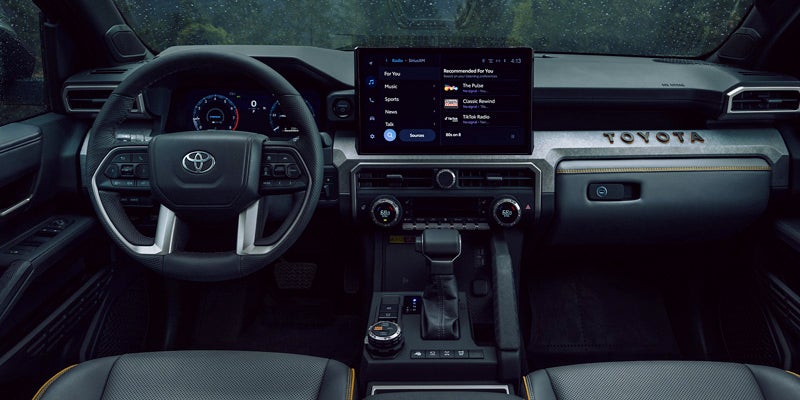
The Explorer and 4Runner share a wide variety of interior options. From leather seats and power moonroofs to Apple CarPlay and wood trim pieces, the two SUVs are fairly evenly matched in terms of cabin options.
Of the two SUVs, only the new Explorer offers standard third-row seating. However, the 4Runner does offer an available third row that you can choose on the SR5 and Limited trims. Three-row models offer space for up to seven passengers.
Both of these models offer robust cargo capacity the flat-folding rear seats found in each. The Explorer holds its own 87.8 cubic feet of cargo space. But the new 4Runner manages to best it with a total of 89.7 cubic feet of cargo space available.
The new 4Runner has a unique feature that you won't find in the 2020 Explorer. New 4Runner SUVs offer an available rear sliding deck that makes loading cargo in and out as easy as possible. The sliding deck can support up to 440 pounds.
Another feature unique to the 4Runner is its power rear glass. The rear window can slide up and down with the press of a button, making it easy to toss in a bag or small item without having to lift the rear hatch.
Capability & Off-Road
The new 4Runner has far superior ground clearance compared to the 2020 Explorer. While the Explorer maxes out at 7.9 inches of ground clearance, the 4Runner comes off the assembly line with 9.6 inches of ground clearance. That's good news for drivers who plan to navigate all-terrain obstacles.
Both the 4Runner and Explorer offer available four-wheel drive systems. However, only the 4Runner offers a true locking rear differential. This features mechanically locks the two rear wheels in rotation sync for superior grip.
The 4Runner and Explorer alike each offer available technology that allows the driver to select from various all-terrain modes. However, 4Runner goes even further. Its innovative Crawl Control feature acts like an off-road cruise control, maintaining a crawling pace so that you can focus on steering through an obstacle.
If you're looking for more standard power, you'll find it in the new Explorer. However, that power comes from a relatively new turbocharged four-cylinder engine. By contrast, Toyota has opted to stick with a 4.0-liter, 270-horsepower V6 in the 4Runner that's has a track record of durability that's nearly two decades long. It's choice that clearly opts for toughness and dependability.